
Maths
Our Vision
At Birchills Church of England Community Academy we believe that every child can achieve highly in mathematics. Through a carefully sequenced and coherent curriculum, supported by Oak National Academy, pupils develop secure number sense, deep conceptual understanding and fluent recall.
Our teaching is underpinned by the NCETM Five Big Ideas of Teaching for Mastery and strengthened through the Mastering Number programme, ensuring pupils develop fluency, reasoning and problem-solving skills. In the early years, children begin their mathematical journey through Maths Champions, where they explore number, pattern and mathematical thinking through purposeful play and discussion.
In our classrooms, pupils are encouraged to feel confident and safe to attempt challenges, knowing that mistakes are part of learning. We promote the use of precise mathematical vocabulary, clear explanations and the expectation that pupils show their working and explain their thinking. Learning is carefully sequenced and scaffolded, allowing pupils to build secure knowledge step by step so they can reason, make connections and apply their understanding.
Teachers support learning through clear modelling and structured teaching approaches such as “I do, we do, you do”, using practical resources, representations and effective questioning to deepen understanding. We maintain high expectations for all pupils, ensuring that everyone accesses the same ambitious curriculum with appropriate support and challenge.
At Birchills, we believe effective mathematics teaching means depth before breadth, giving all pupils the opportunity to succeed. Pupils work together on the same learning while adaptations and scaffolds ensure that every child can progress. Our aim is that pupils leave Birchills as confident, articulate and resilient mathematicians who can reason clearly, explain their thinking and apply their learning successfully in new contexts.
.
A Mastery Approach
At Birchills Church of England Community Academy, we teach mathematics through a year-group mastery approach so that all children develop secure number sense, fluency and confidence. Learning is carefully sequenced in small steps, using practical resources, visual models and precise mathematical language. All pupils are supported and challenged to reason, solve problems and explain their thinking, ensuring strong foundations for future learning.
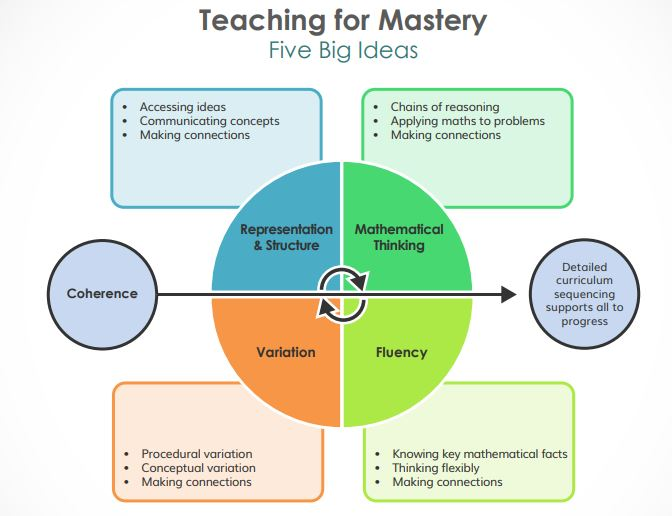
Our Mastery approach is underpinned by the Five Big Ideas of Mastery which is outlined below.
Coherence
Learning is carefully sequenced so that each new concept builds on prior knowledge. This helps children make connections, apply their learning and explain their thinking with confidence.
Representation and Structure
We use concrete resources, pictorial models and abstract symbols to help pupils see the mathematics. These representations reveal mathematical structure and support children in developing strong mental images and understanding.
Mathematical Thinking
Children are encouraged to think mathematically in every lesson by spotting patterns, making connections, reasoning and explaining their ideas using accurate mathematical language.
Fluency
Fluency is about more than speed. Pupils develop secure knowledge of key facts and procedures, alongside the flexibility to choose efficient strategies and solve problems confidently.
Variation
Teachers carefully vary examples and tasks to draw attention to key mathematical ideas. This helps pupils notice what stays the same and what changes, deepening understanding.
Through this approach, children become confident, capable mathematicians who are well prepared for the next stage of their learning.